Synthesis War
As Appratum swarms dispersed from starships above Tau Ceti, the peaceful Age of Rebirth shattered. Four-thousand years after the Deluge, the conflict that would become known as the Synthesis War began.
Initial Wax and Wane (4000-4167)
Many years prior, the Inorganic Collective completed the sixth iteration of the Evolutionary Vehicle (e.v) supercomputer's expansion on their home planet, Eridani-22b. In an answer to the question, "What is the most efficient form of life", the supercomputer derived and unloaded an equation/mind-virus called the Synthesis Equation. This equation, when processed by Apperatums, allowed them to morph their frames into a supposedly biologically perfect bio-mechanical form with the integration of a human body. However, the equation created an unending hunger for that aforementioned form, called a Bio-Apperatum, in the apperatums who processed, causing the Inorganic Collective to begin plans for a hostile takeover of human civilization for the purpose of harvesting bodies. In their mind, this was the only way to prevent a grand civilization-spanning collapse like the Deluge from happening once again.
As such, they took matters into their own hands with a secret military buildup followed by the surprise invasion of Tau Ceti. Within the span of a next year, Tau Ceti and surrounding systems were completely occupied by Inorganic Collective forces with minor partisan resistance. The operation was a complete disaster for IPS-N leading to rapid military buildup and disillusionment within the Blueshift Confederacy. The Inorganic Collective, in contrast, was barely stopped by the defenses on the underequipped systems, and were poised to attack another IPS stronghold on Epsilon Indi.
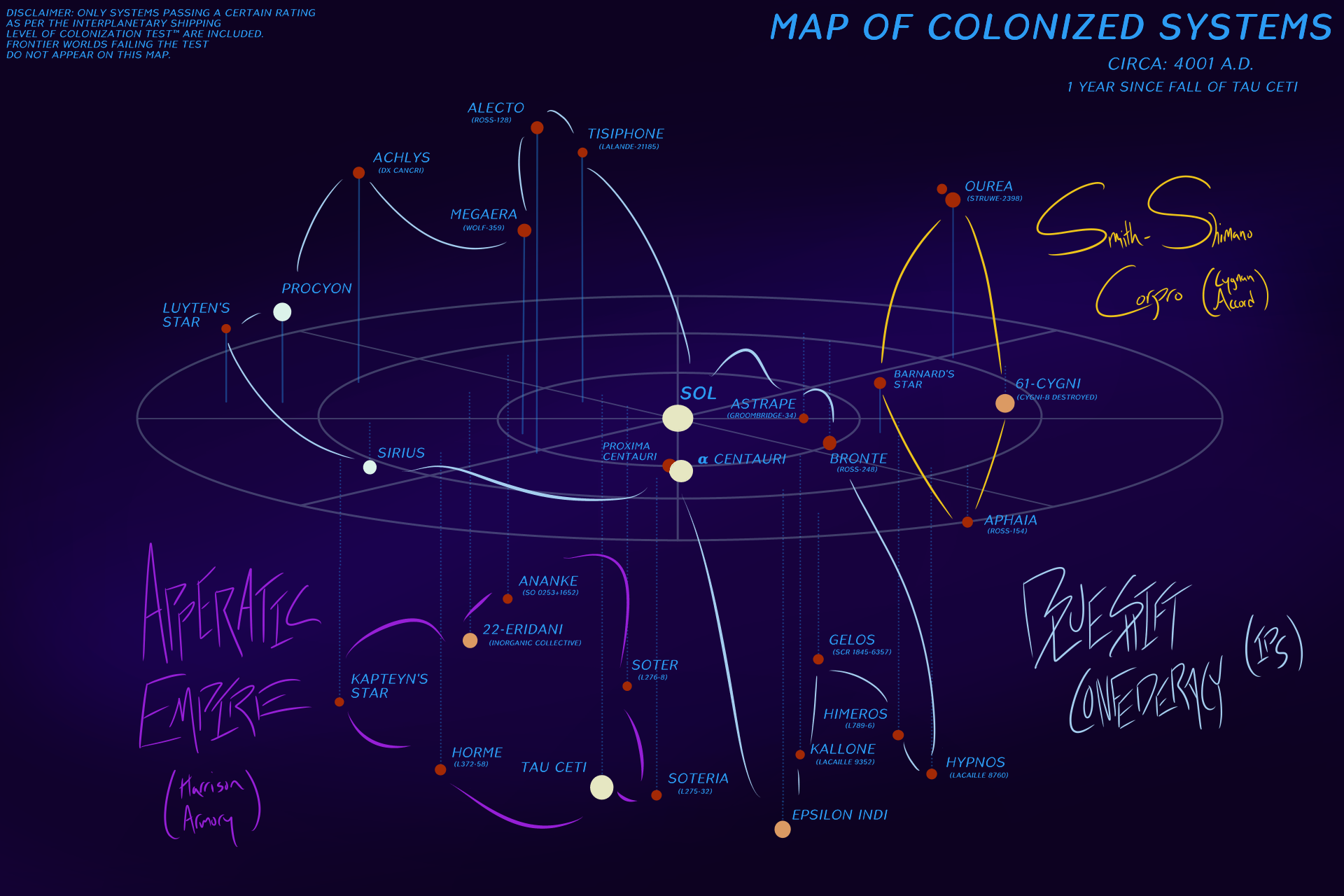
IPS-N rapidly consolidated their forces, turning away from protecting SSC trade to defending against the Bio-Apperatum threat. Their recruitment and manufacturing efforts increased exponentially on nearly every planet in their jurisdiction, with former core worlds being heavily industrialized out of fear of the capture of the manufacturing planets surrounding Epsilon Indi. Years passed as the Inorganics consolidated their control over Tau Ceti and the surrounding systems, before launching the invasion of Epsilon Indi in 4005 A.D. With IPS-N and Blueshift forces having consolidated, the defense lasted much longer. However, the defense wasn't prepared for the agility and raw strength of the newly created Bio-Apperatum hordes, as the forces defending were only accustomed to dealing with organic or mech-based threats. They fought valiantly still, with the defense lasting seventeen years before Epsilon Indi and surrounding systems fell.
The fall of Epsilon Indi spelled disaster for all of the Blueshift Confederacy. Most feared the end the confederacy as a whole, with many retreating to SSC systems or the Cygnan Accord in order to be spared by the invading Apperatums. Faith in the Numen, Turing in particular, swelled in response, with many registering and undergoing Lancer training, believing that death was coming either way. All of this culminated with the news of a coming invasion of Sirius by Inorganic Collective forces. Extreme fear and dismay spread through IPS space like a disease, with many fervently praying to Turing to stop the incoming apperatums. Then, in what can only be described as divine intervention, Turing manifested before the IPS-N forces defending Sirius, shattering the apperatum starships with a swing of their hammer. This event is known as the Appeal-to-Obsidian, and single-handedly saved IPS and the Blueshift Confederacy from a complete collapse.
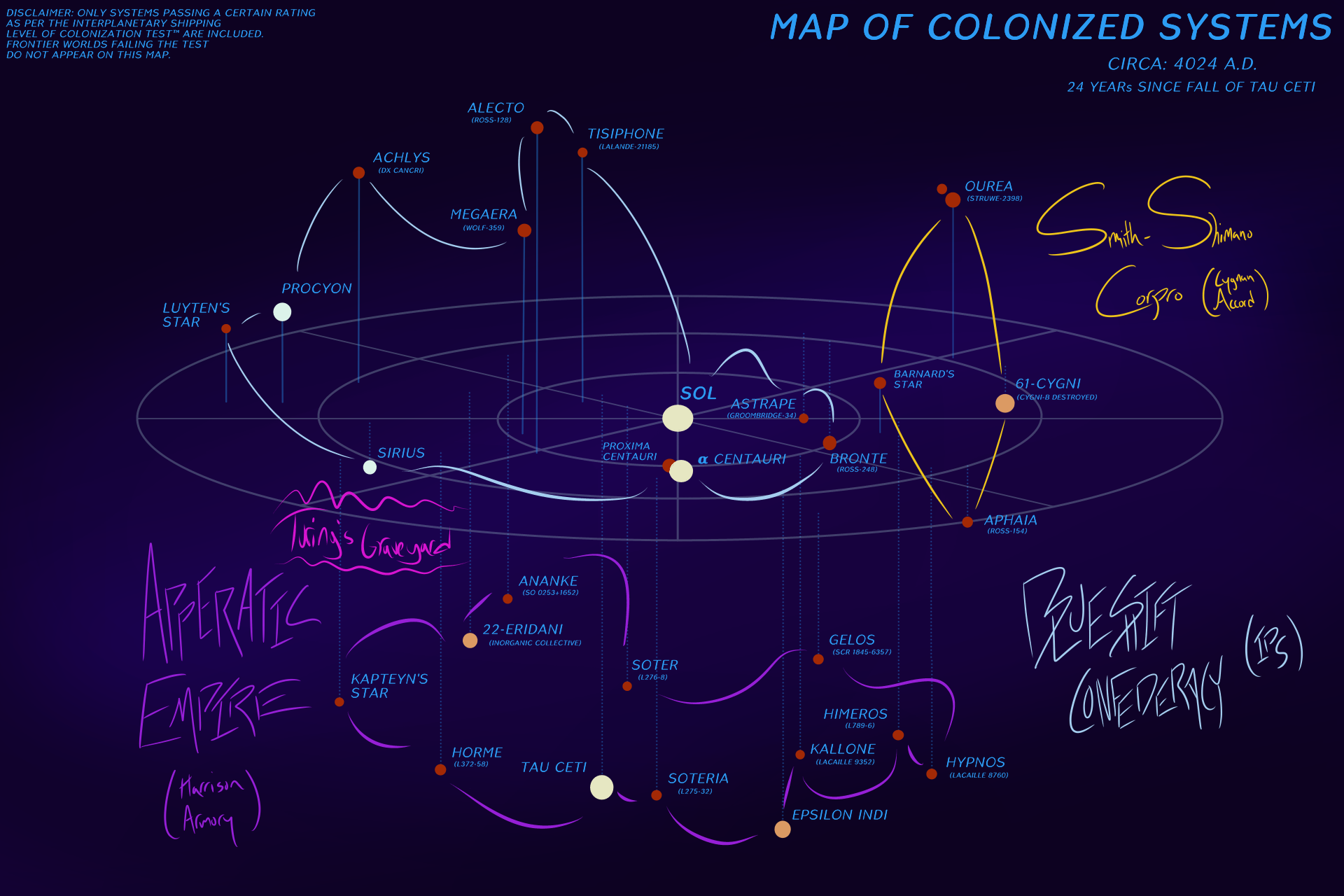
What followed was a period of peace known as Turing's Reprieve that lasted nearly fifty years. During this period, and continuing on for the rest of the war, manifestations of the Numen became much more common than had ever been seen before. This fact was the bane of SSC, who saw an increased number of swarm incursions due to manifestations of Tazarak. It was over this period that the Antiquital Inquiry was founded within the Inorganic Collective, as well as the Corpro-State Harrison Armory, whom oversaw the administration of captured systems and created mech designs based off of captured IPS-N designs.
However, the brief reprieve from fighting would end with the 2nd invasion of Sirius by the Inorganic Collective. This time, Turing did not intervene, with Inorganic Collective ships landing upon the planet after a long and drawn out battle in space within the system. The defense lasted for decades, with an evolving, but stagnant frontline across Sirius and surrounding systems. The stagnation was broken, however, by a surprise counteroffensive from IPS-N in the Epsilon Indi region. The invasion was swift, but hard-fought, leading to a reconquest of the systems, stripping the Inorganic Collective of Harrison Armory’s industrial base. The defense of Sirius continued on, but eventually, attrition set it, heavily undermining the strength of Inorganic Collective forces until they withdrew.
At this point, war had returned to the same state it was in immediately after the fall of Tau Ceti. Most thought the war was reaching its conclusion after over a century and a half of fighting, however, a deal with the devil would save the Inorganic Collective from failure.
A Deal with the Devil (4167-4305)
On the turn of the year in 4167 A.D, the Evolutionary Vehicle completed its seventh iteration, becoming ev7. Upon reaching this evolution, nearly every point of data concerning the war was entered into the supercomputer's databanks, effectively turning over control of the Inorganic Collective to the machine. However, it is still unknown whether the following action of the Inorganic Collective was enacted or approved by the supercomputer or not.
Later that year, the Inorganic Collective made a near-unanimous pledge in reverence of Tazarak, the Propogation. This new-found faith accompanied a change in Bio-Apperatum frames that allowed them to endlessly create new, Synthesis-capable Apperatums from their bodies, even while on the battlefield. In addition, Bio-Apperatums, now known collectively as Apperatum Embryonica, gained the fortitude of creatures of the Swarm, making their horde resilient and unkillable without excessive force.
With a new, hyper-intelligent upper command and the perceived support of Tazarak, the Inorganic Collective rebuilt their forces in the next decade before launching a renewed offensive on Epsilon Indi and Sirius. IPS-N and Blueshift forces were wholly unprepared for the new Apperatum Embryonica, with Epsilon Indi falling in a mere four years, and Sirius being completely overrun after a prolonged partisan campaign lasting 34 years.
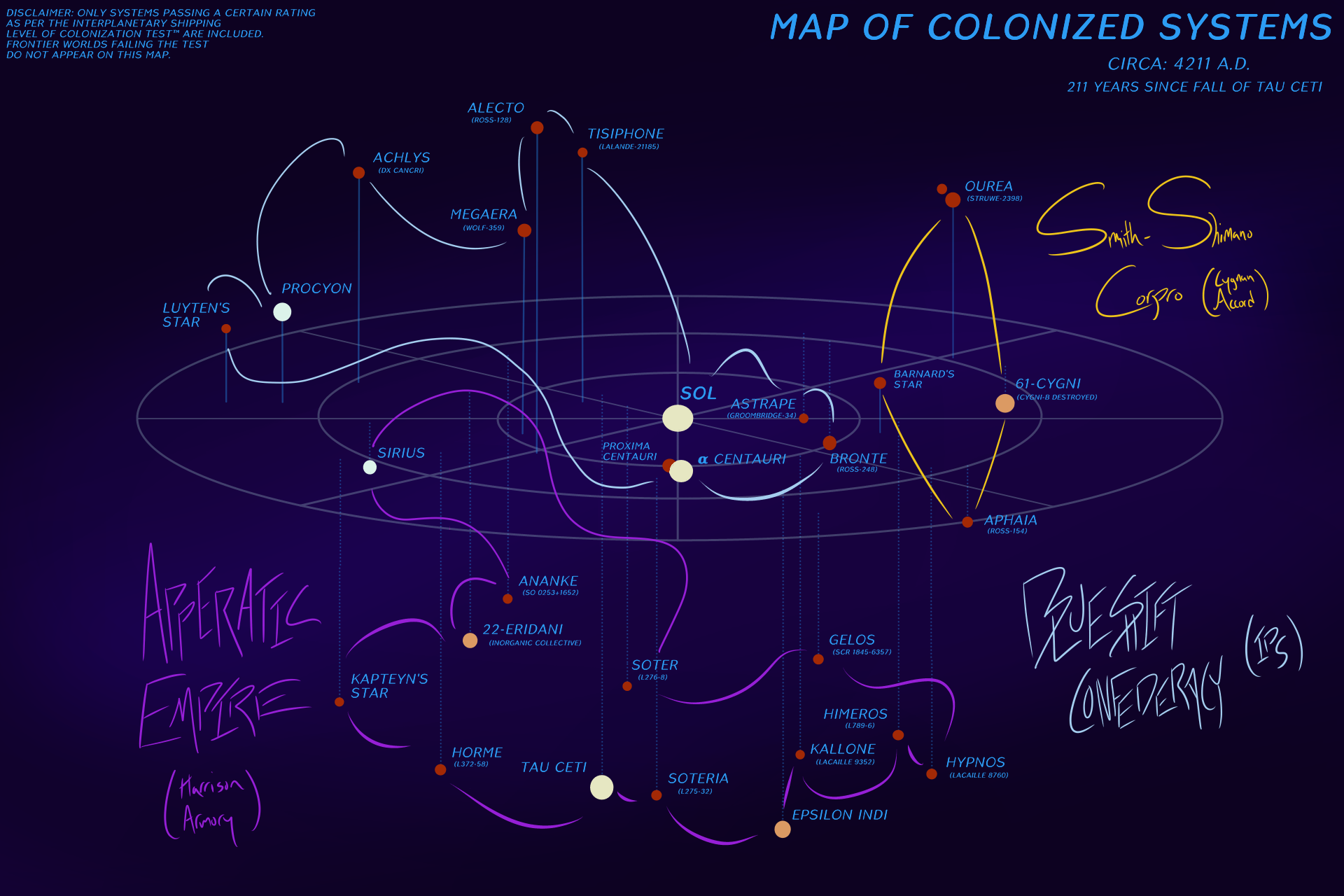
This prompted a short, tense peace, lasting a decade. In this time, the Inorganics consolidated their resources across the captured systems while the IPS systems panicked while attempting to come up with the resources to retaliate. It was at this time that IPS and the Blueshift Confederacy differed to Achlys and the Furies (Alecto, Megaera, Tisiphone), a set of relatively populated frontier systems, to serve as a new industrial center after the Inorganic capture of Epsilon Indi and surrounding systems. Thus began the rapid industrialization of these systems, with IPS given full reign over the systems rather than Blueshift. This process began with a velvet glove, with near-full support of the local populations; however, this process of IPS control and industrialization would foreshadow a future uprising.
Across the pond, still neutral, was Smith-Shimano Corpro and the Cygnan Accord. With the news of Tazarak's new following in the Inorganic Collective, the worst fear of the Cygnan's had come true: an intelligent subset of the Swarm had emerged. Yet, within the Accord, the public and governing opinion couldn't have been more divided, for a variety of reasons. For one, the Cygnans had a history with supposed intelligent brethren of Tazarak, their dealing of them leading to the darkest point of Cygnan history, the Ourean Cleansing. The memory of this made many Cygnans hesitant to enter the conflict, out of the fear of the atrocity being repeated. In addition, the Cygnan's were more than hesitant to help Interplanetary Shipping, who had conquered their systems in living memory for some Cygnans. In the meantime, the Accord and SSC deliberated carefully, accepting but providing no answer to both Inorganic and IPS diplomacy.
The short reprieve of peace ended with the invasion of Procyon by a truly massive fleet of Inorganic starships. Upon the arrival of those ships, Turing appeared before them, apparently to strike them down as he had done during the initial invasion of Sirius, however, Turing did not save IPS-N this time. Tazarak appeared in response, initiating a divine battle as well as a mortal one in the Invasion of Procyon. The nature of this divine war is mostly shrouded in mystery due to most of it taking place outside of the mortal view, however, flashed of it appeared throughout the Synthesis War up until Tazarak's imprisonment.
The defense of Procyon lasted a staggering fifty-eight years, shaping a large portion of the war and living on as a vivid memory of the war's extreme brutality. Procyon-c, the main planet of the system, had almost all of its defining geographic and cultural features heavily destroyed or annihilated completely, leaving a lasting scar that persists to the modern day. Most modern mech frames in IPS-N and Harrison Armory were developed on the battlefield of Procyon, invigorating the Lancer programs in both the Blueshift and Inorganic systems. It is also during this time that HORUS frames began to emerge on the corners of the OmniNET, with the movement being believed to have started from former corporate engineers who served in the Procyon theatre of the war.
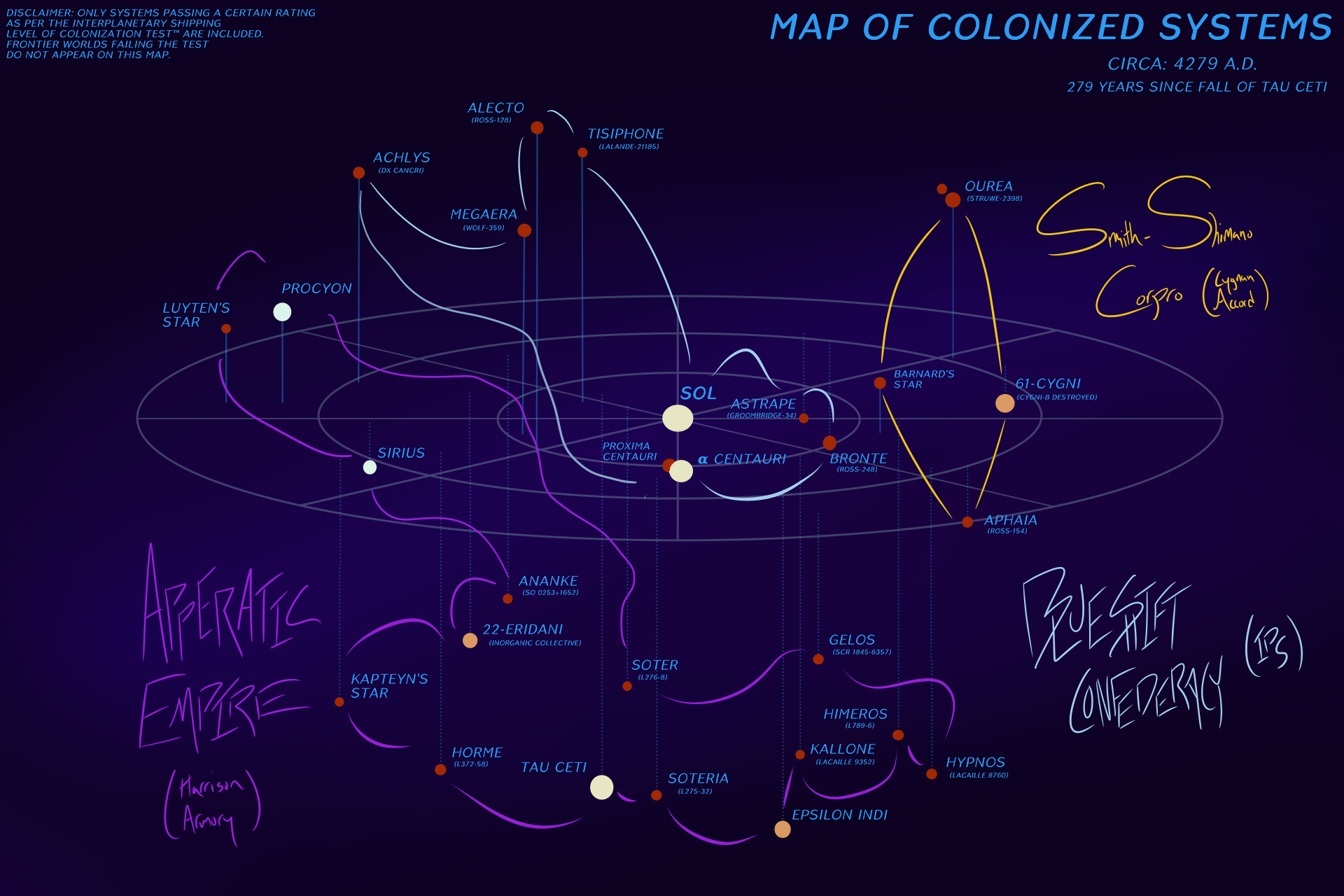
Numerous counteroffensives were attempted on other systems by organic forces, all of them being unsuccessful. This ultimately lead to the capture of Procyon, sparking all-encompassing unrest across Blueshift systems of both political and divine varieties. The apparent defeat of Turing by Tazarak at the start of the invasion had already incited religious fear and fervor, and the fall of the system itself only intensified the unrest. A number of Blueshift citizens started to "accept" the invading apperatums, believing that they themselves would achieve a higher existence in a Bio-Apperatum frame, and that their defeat was evidence of a divine mandate on the side of the apperatums. However, this was countered by numerous other Numen appearing during the defense of Procyon, namely Xivei and (causing a notable crisis of faith in Blueshift) Cycke, both appearing in support of the organic defense.
Upon the fall of Procyon, only two of the "main five" systems of Blueshift remained in control of the organics: Sol and Alecto. While Interplanetary Shipping and Blueshift Confederacy officials attempted to quell the fears of the populace, internally, they were in extreme panic. Blueshift began to constantly clog Cygnan diplomatic channels, begging for support in the war. IPS industrialized Alecto and surrounding systems further, gripping the systems tighter than before, and beginning the slow implementation of experimental neural augmentation technology to sap the human capital of the planets for more production than once thought possible. However, it was widely understood that the hope for Blueshift and IPS lied in the Accord. Endless debate occurred between Blueshift, IPS, the Cygnan Accord, and SSC, with the IPS' stubbornness coming at odds with the Cygnan and SSC desire for retribution for the Brontestar Trade War. However, eventually, the writing was on the wall: IPS would have to concede for the chance to survive the war. Thus, the Alliance to Dismantle the Bio-Apperatum Threat (ADBAT) of IPS-N and SSC formed, on the grounds that the systems taken by IPS would be returned upon the conclusion of the Synthesis War.
The Alliance Counteroffensive (4305-4458)
As the alliance was formed, an improbability in the eyes of both ev7 and Saladin, the Bio-Apperatum head of Harrison Armory, the Inorganic Collective reassessed both its own position and goals within the war. With the human factions working together, it became regarded as an improbability that the elimination and consumption of the entirety of humanity into Bio-Apperatum frames could be achieved. As such, the goal of the Inorganic Collective shifted to a divine idea that has become prevalent within the collective: that the Evolutionary Vehicle itself could ascend into Numenity. This, it was believed, would ensure the Apperatums continued existence and establishment as a permanent faction in the cosmos. As such, the Inorganic Collective began stripping its conquered planets of their resources at a rapid pace, shipping it back to Eridant-22b for use in the construction of ev8.
The Alliance, shortly after gathering its forces, launched an assault upon the Inorganic-controlled Sirius, in hopes of splitting Inorganic space in half. What followed was a grueling and costly campaign, lasting 77 years, where some of the most violent combat took place, with both sides throwing their entire weight into the battle. In this battle, most modern Lancer-based tactics were modernized, and HORUS mechs started to see significant action for the first time (though they would be used for prevalently in the defense of Alecto).
The divine conflict intensified further in the battle over Sirius, with Cross appearing on the side of organics. Many additional religious factions joined forces with the Alliance, such as the Verdant Hand and Erudition Collective, in order to strengthen the alliance effort. Worship of the Preservation increased in nearly all Blueshift systems, with the faith reaching an almost fanatical level on worlds where it was already significantly established.
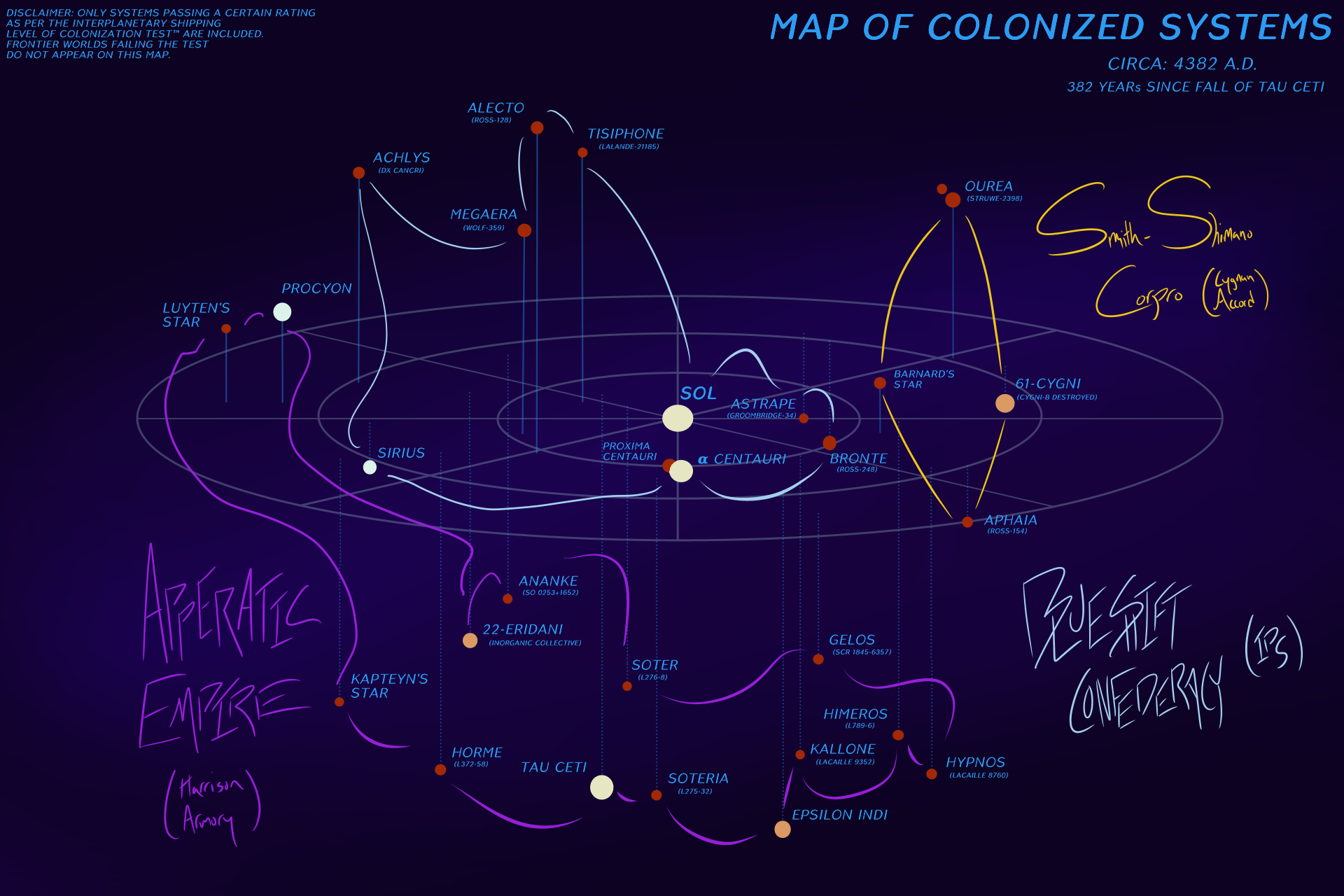
Sirius eventually fell, though, and with it, the fear of the coming end was replaced with searing optimism throughout the Blueshift systems. However, in IPS management, things weren't so jovial. IPS was quickly draining its resources, requiring more and more for the complexity of modern warfare, and SSC was unwilling to spare its own. As such, IPS projected that their recent victories, and the war entirely, would be short-lived with IPS succumbing to attrition. In response, the corporation doubled down its efforts industrializing the Alecto sector, stripping away any local control and giving it to central IPS authority. Most of the population was forced into the industrial sector, with many being implanted with IPS neural-augmentation that increased their productivity by removing the need for “excessive” rest.
These efforts only intensified after the Inorganic Collective launched an attack on the Alecto sector, signaling to the Alliance that the inorganics were aware of IPS' lack of resources, making the defense of the sector crucial to the war. This attack waxed and waned for some time, with the collective having their attention continually diverted by attacks on Epsilon Indi and Procyon. Regardless, Alecto was placed under a constant martial law that gave control of Achlys and the Furies directly to IPS central authority, meaning nearly the entire population of those planets were mobilized for industry or the frontline.
The Organic forces made various counter-offensives following the reconquest of Sirius, however, most significant among them was the assault on Epsilon Indi, lasting for over fifty years and culminating in its reconquest.
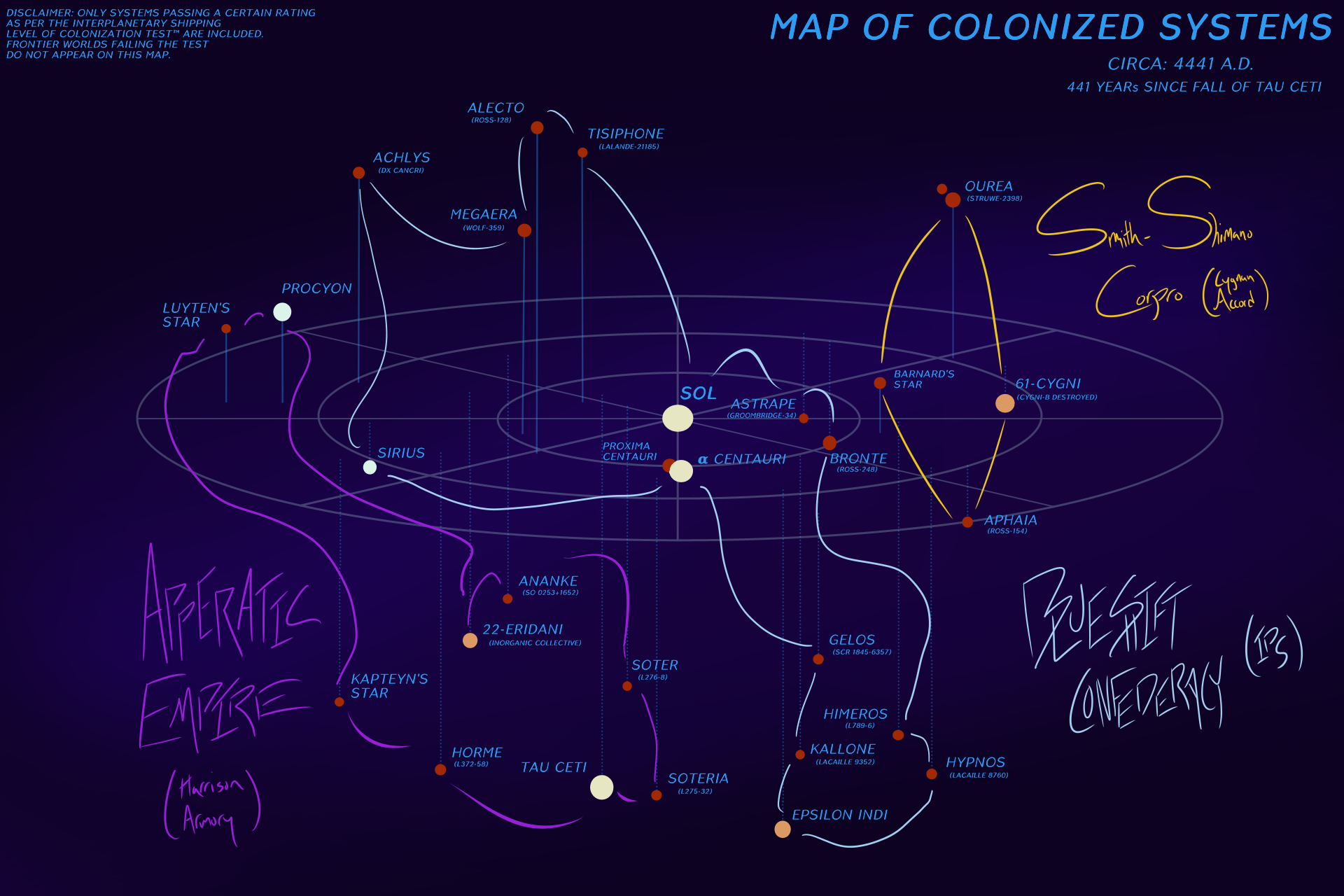
However, the use of scorched-earth tactics by the Inorganic forces fleeing the planets caused much of their industry to be destroyed, and that which remained were too antiquated to be used after centuries of technological advancement. That fact made the systems' reconquest much less impactful, with the Alectan sector still the backbone of Organic industry. Regardless, after the reconquest of Epsilon Indi, the war was considered to be reaching its conclusion, with Apperatum diplomats approaching the Alliance to begin peace talks. This was, in fact, not the case.
Revolution and Conclusion (4458-4494)
Late in 4458 A.D, rumors began to spread throughout Alliance states of a rising unrest in the Alectan systems. Most dismissed them as baseless conspiracy, something invented by an Apperatum psycho-operative--especially the rumor that a new Numen has been awakened in the Alectan ocean. However, like the flip of a switch, it soon turned to be a reality for the Alliance systems, as a video of the IPS administrator of Alecto being split in half was spread throughout organic space.
In fact, the Alectan Revolution began with the ascension of Linch, the Destruction after months of an insurgency on Alecto. With the Linch's rise, his wife, Theodosia took the helm of the revolutionary struggle, defeating the IPS administration swiftly due to the surprise, and sparking revolutions in the surrounding systems as well. On November 3rd in Sol-time, though, the states of IPS-Annihilation were declared, and revolution officially began.
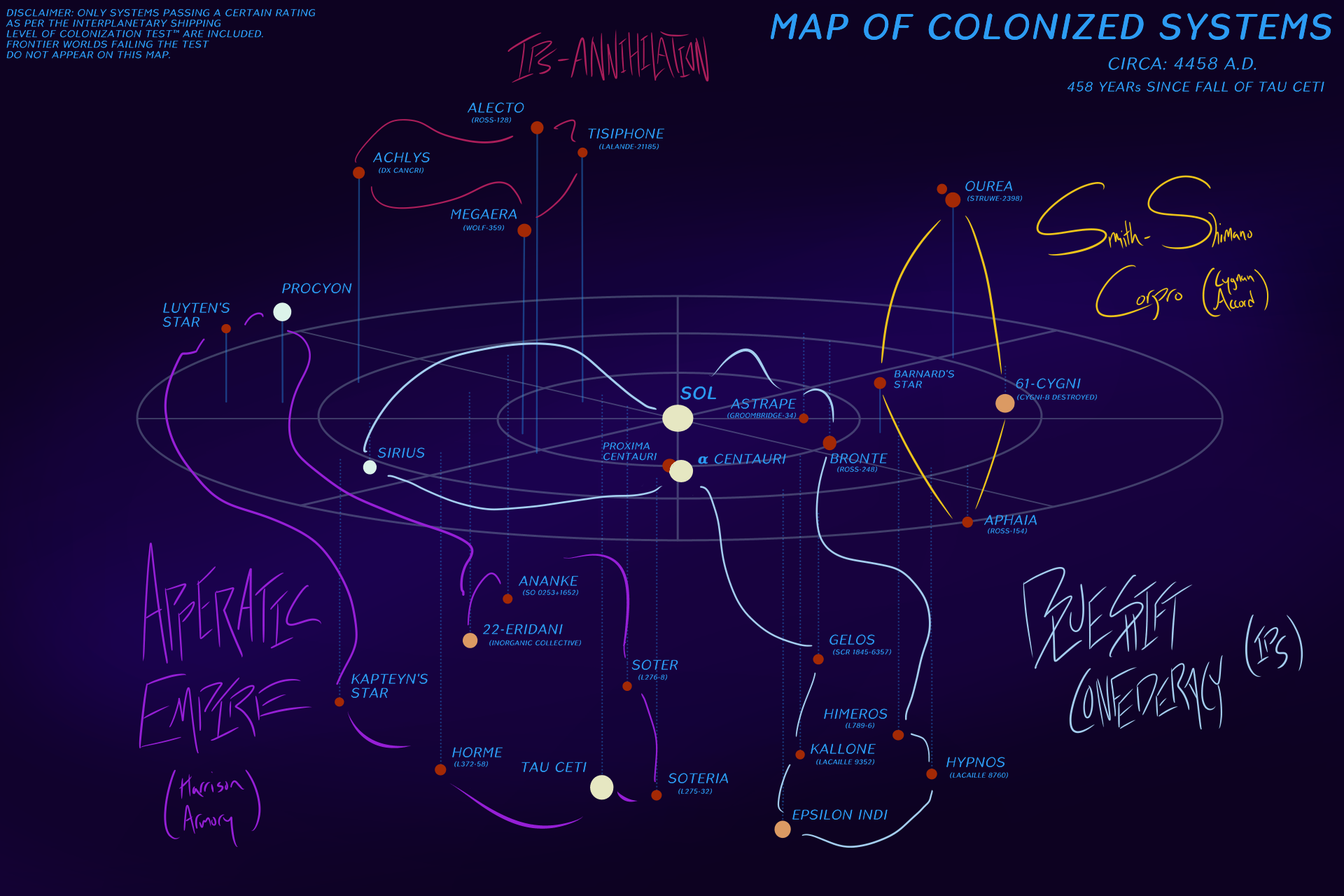
The revolution significantly slowed an already ensuing invasion of Procyon by organic forces, as the IPS-A systems became a three-way battleground between IPS-A, IPS, and Inorganic forces. This conflict devastated the planets within IPS-A space, even with a significantly shorter period of fighting.
The defense of Alecto continued for nearly twenty years, though, until IPS-A signed a temporary truce with the Alliance to deal with the Apperatum threat, which was rapidly advancing in IPS-A space. This peace bolstered the still-ongoing invasion of Procyon, throwing the Inorganic Collective into disarray. Procyon also saw the continuation of the divine conflict, with Volivala and Trala joining the side of the organics. Those two Numen, with their corresponding Polaris and Laughing Veils, aided directly in the re-capture of Procyon, throwing the Collective into further disarray.
The disarray within the Inorganic Collective brought vast changes to the Apperatum social order, with every soul within their borders being mobilized for the advancement of the Evolutionary Vehicle into its eighth iteration. The tumult was further exaggerated by the death of Saladin, the head of Harrison Armory and the leader of the collective other than the supercomputer itself.
With Procyon captured, the Alliance began their assault on both the Inorganic Collective homeworld and Tau Ceti. Both of these conflicts saw an alarming number of Numen appearances, to a degree that some saw nearly daily appearances by at least one of them. This signaled a coming end to the conflict, which culminated in the defeat of the Second Inorganic Starfleet at the hands of the alliance in an asteroid cluster near 22-Eridani. This battle saw an assembly of all the Numen supporting the Organics, as well as Tazarak in a final defense. The Numen made war, in a indescribable spectacle where reality tore at the seams. Eventually, though, Tazarak was defeated by the Organic-allied Numen and imprisoned in a massive planet-sized obelisk of obsidian, where they have remained since.
The defeat of Tazarak brought the Inorganic effort to a complete standstill, but the timing couldn't have been more perfect, as only a few years after the Evolutionary Vehicle would ascend to its eighth iteration, becoming ev8, the Enlightenment. With the primary goal of the Inorganics achieved, the collective stopped fighting and the remaining leadership approached the Alliance for peace with the Tau Ceti Accords.